


Characterized by their lightweight nature, low thermal conductivity, superhydrophobicity, and engineered composite properties, aerogel fiber felts have become key materials for addressing global needs regarding energy conservation, carbon reduction, and safety protection. Driven by both policy initiatives and technological advancements, their application scope is rapidly expanding. Aerogel fiber felts are now utilized across diverse industries, ranging from oil and gas pipeline insulation and green building applications to high-end scenarios such as extreme thermal protection for deep-space exploration and battery safety in new energy vehicles.
1. Industrial Thermal Insulation
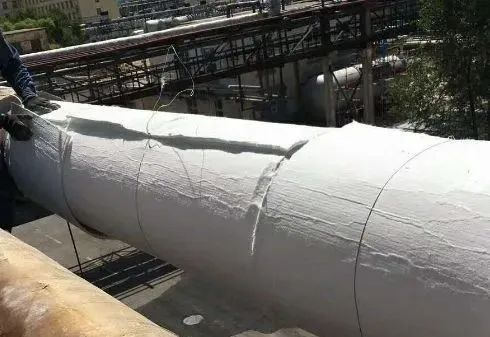
In steam pipeline insulation retrofit projects, a composite insulation scheme utilizing aerogel felt and aluminum silicate blanket significantly reduces the temperature difference between the insulation’s outer surface and the ambient environment compared to pre-retrofit conditions. This approach achieves energy savings of up to 75.7%, offers an estimated investment payback period of 1.1 to 2.1 years, reduces carbon emissions by 11,000 tons, and yields energy cost savings of 8.75 million RMB over a decade. For steam turbine main steam pipelines, a 90 mm thick layer of aerogel material outperforms 360 mm of traditional insulation; the outer surface temperature is 4–5°C lower, and heat loss is reduced by approximately 66.7%. In one specific steam turbine insulation project, aerogel felt replaced the original aluminum silicate felt; the retrofit resulted in an outer surface temperature approximately 25°C lower than the original setup and a 40% reduction in insulation thickness, thereby significantly saving space.
2.Building Energy Efficiency
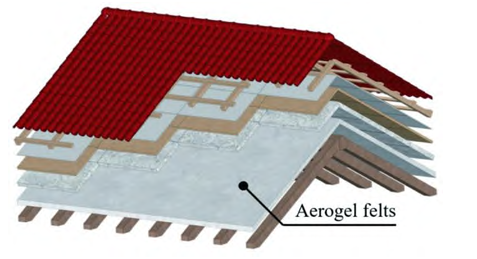
Energy-efficient retrofitting of older residential communities is a crucial step in urban renewal and the low-carbon transformation of the building sector. Aerogel materials are employed to upgrade and optimize the exterior walls, roofs, and transparent envelope structures of existing buildings, thereby reducing energy consumption and enhancing resident comfort. Due to their advantages—being thin, lightweight, and hydrophobic—they are particularly well-suited for projects with strict energy-saving requirements and spatial constraints, such as the retrofitting of existing buildings. Researchers have proposed a design for energy-saving windows incorporating aerogel felt and conducted a feasibility analysis, including simulations regarding the thickness of the aerogel felt used in transparent envelope structures. Results showed that with a 6 mm thick aerogel felt, heating energy consumption decreased by 30.73 kWh (an energy-saving rate of 57.04%), and the average temperature of the south-facing balcony during the coldest month rose by 6.51°C. Installing aerogel felt on building walls effectively enhances their fire resistance. When silica aerogel fiberglass felt was used to retrofit light-gauge steel frame load-bearing walls as external insulation, the temperature difference at the wall stud flange was reduced by 200°C, and the time lag for temperature rise was extended by approximately 20 minutes compared to walls with cavity insulation.
3.New Energy Sector
Aerogel fiber felt represents the state-of-the-art in thermal insulation materials, characterized by a comprehensive set of properties: thinness, lightness, strength, durability, and hydrophobicity. It serves as a key technological enabler for achieving deep energy conservation and “dual-carbon” goals, making it particularly suitable for applications with stringent requirements regarding energy efficiency, safety, and space constraints. In new energy vehicles, the safety of power battery packs is paramount. Aerogel fiber felt is primarily used inside battery packs as a thermal insulation and fire-protection material; it provides precise thermal isolation to prevent the propagation of thermal runaway. When a single cell undergoes thermal runaway and generates extreme temperatures instantaneously, the aerogel fiber felt—despite its minimal thickness—provides prolonged high-temperature isolation, acting as a “firewall” between cells. Experimental studies demonstrate that thermal runaway suppression improves with increased aerogel felt thickness: while 1 mm felt failed to suppress heat transfer between battery modules, 3 mm and 6 mm felts extended the propagation time of thermal runaway. Specifically, 3 mm felt increased the thermal barrier efficiency of battery modules by 299.92%, and 10 mm felt completely blocked the propagation of thermal runaway, effectively ensuring the safety of the battery pack assembly. Simulations of heat transfer following a short-circuit-induced fire in a battery cell demonstrate that, at the 300-second mark, the center temperature of an adjacent cell is reduced by approximately 64.4% when a 3 mm thermal insulation and flame-retardant layer is applied, compared to a configuration without such a layer. The ultra-low thermal conductivity and Class A flame-retardant properties of aerogel fiber mats effectively address the severe thermal challenges posed by the high energy density and rapid charge/discharge capabilities of modern power batteries, ensuring the battery pack maintains structural integrity and stable performance under extreme conditions.
Aerogel fiber blankets represent a technological leap in high-performance thermal insulation. Whether it’s reducing energy loss in high-temperature industrial pipelines, maximizing space and fire safety in retrofitted green buildings, or providing critical thermal runaway barriers for EV battery packs—aerogel materials deliver unmatched protection in remarkably thin profiles.
Post time: Sep-18-2026


