


The inner layer of a fiber-wound pressure vessel is primarily a lining structure, whose main function is to act as a sealing barrier to prevent leakage of the high-pressure gas or liquid stored inside, while also protecting the outer fiber-wound layer. This layer is not corroded by the internal stored material, and the outer layer is a resin-reinforced fiber-wound layer, mainly used to bear most of the pressure load within the pressure vessel.
The structure of a fiber-wound pressure vessel: Composite material pressure vessels mainly come in four structural forms: cylindrical, spherical, annular, and rectangular. A circular vessel consists of a cylindrical section and two heads. Metal pressure vessels are manufactured in simple shapes, with excess strength reserves in the axial direction. Under internal pressure, the longitudinal and latitudinal stresses of a spherical vessel are equal, and it is half the circumferential stress of a cylindrical vessel. Metal materials have equal strength in all directions; therefore, spherical metal vessels are designed for equal strength and have the minimum mass for a given volume and pressure. The stress state of a spherical vessel is ideal, and the vessel wall can be made the thinnest. However, due to the greater difficulty in manufacturing spherical vessels, they are generally only used in special applications such as spacecraft. Ring-shaped containers are rare in industrial production, but their structure is still necessary in certain specific situations. For example, spacecraft employ this special structure to make full use of limited space. Rectangular containers are mainly used to maximize space utilization when space is limited, such as rectangular tank cars for automobiles and railway tank cars. These containers are generally low-pressure or atmospheric-pressure vessels, and lighter weight is preferred.
The complexity of the composite material pressure vessel structure, the sudden changes in the end caps and their thickness, and the variable thickness and angle of the end caps bring many difficulties to design, analysis, calculation, and molding. Sometimes, composite material pressure vessels not only require winding at different angles and speed ratios in the end caps, but also require different winding methods depending on the structure. Simultaneously, the influence of practical factors such as the coefficient of friction must be considered. Therefore, only a correct and reasonable structural design can properly guide the winding production process of composite material pressure vessels, thereby producing lightweight composite material pressure vessel products that meet design requirements.
Materials for Fiber-Wound Pressure Vessels
The fiber-wound layer, as the main load-bearing component, must possess high strength, high modulus, low density, thermal stability, good resin wettability, good winding processability, and uniform fiber bundle tightness. Commonly used reinforcing fiber materials for lightweight composite pressure vessels include carbon fiber, PBO fiber, aramid fiber, and ultra-high molecular weight polyethylene fiber.
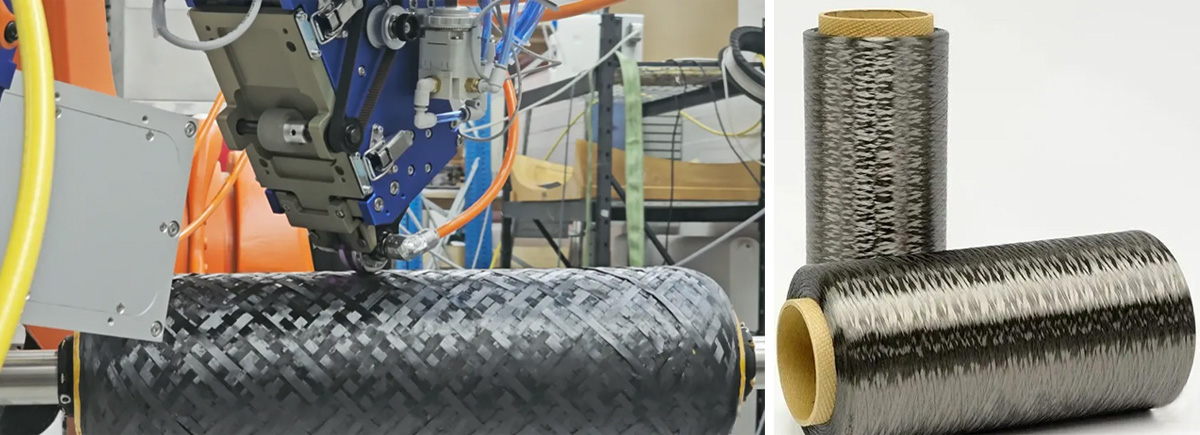
Carbon fiber is a fibrous carbon material whose main component is carbon. It is formed by carbonizing organic fiber precursors at high temperatures and is a high-performance fiber material with a carbon content exceeding 95%. Carbon fiber has excellent properties, and research on it began over 100 years ago. It is a high-strength, high-modulus, and low-density high-performance wound fiber material, mainly characterized by the following:
1. Low density and light weight. The density of carbon fiber is 1.7~2 g/cm³, equivalent to 1/4 the density of steel and 1/2 the density of aluminum alloy.
2. High strength and high modulus: Its strength is 4-5 times higher than steel, and its elastic modulus is 5-6 times higher than aluminum alloys, exhibiting absolute elastic recovery (Zhang Eryong and Sun Yan, 2020). The tensile strength and elastic modulus of carbon fiber can reach 3500-6300 MPa and 230-700 GPa, respectively.
3. Low coefficient of thermal expansion: The thermal conductivity of carbon fiber decreases with increasing temperature, making it resistant to rapid cooling and heating. It will not crack even after cooling from several thousand degrees Celsius to room temperature, and it will not melt or soften in a non-oxidizing atmosphere at 3000℃; it will not become brittle at liquid temperatures.
4. Good corrosion resistance: Carbon fiber is inert to acids and can withstand strong acids such as concentrated hydrochloric acid and sulfuric acid. Furthermore, carbon fiber composites also possess characteristics such as radiation resistance, good chemical stability, the ability to absorb toxic gases, and neutron moderation, making them widely applicable in aerospace, military, and many other fields.
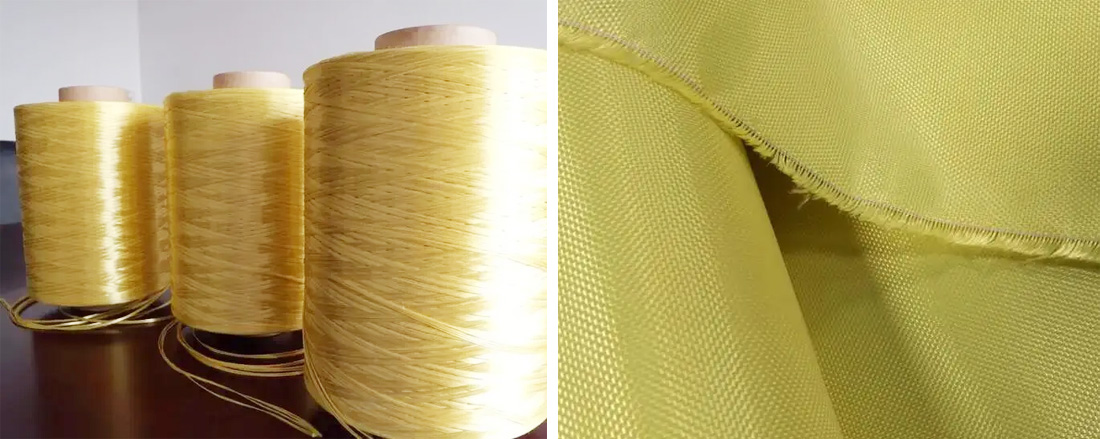
Aramid, an organic fiber synthesized from aromatic polyphthalamides, emerged in the late 1960s. Its density is lower than that of carbon fiber. It possesses high strength, high yield, good impact resistance, good chemical stability, and heat resistance, and its price is only half that of carbon fiber. Aramid fibers mainly have the following characteristics:
1. Good mechanical properties. Aramid fiber is a flexible polymer with higher tensile strength than ordinary polyesters, cotton, and nylon. It has greater elongation, a soft hand feel, and good spinnability, allowing it to be made into fibers of different fineness and length.
2. Excellent flame retardant and heat resistance. Aramid has a limiting oxygen index greater than 28, so it does not continue to burn after being removed from a flame. It has good thermal stability, can be used continuously at 205℃, and maintains high strength even at temperatures above 205℃. Simultaneously, aramid fibers have a high decomposition temperature, maintaining high strength even at high temperatures, and only begin to carbonize at temperatures above 370℃.
3. Stable chemical properties. Aramid fibers exhibit excellent resistance to most chemicals, can withstand most high concentrations of inorganic acids, and have good alkali resistance at room temperature.
4. Excellent mechanical properties. It possesses outstanding mechanical properties such as ultra-high strength, high modulus, and light weight. Its strength is 5-6 times that of steel wire, its elastic modulus is 2-3 times that of steel wire or glass fiber, its toughness is twice that of steel wire, and its weight is only 1/5 that of steel wire. Aromatic polyamide fibers have long been widely used high-performance fiber materials, primarily suitable for aerospace and aviation pressure vessels with stringent requirements for quality and shape.
PBO fiber was developed in the United States in the 1980s as a reinforcing material for composite materials developed for the aerospace industry. It is one of the most promising members of the polyamide family containing heterocyclic aromatic compounds and is known as the super fiber of the 21st century. PBO fiber possesses excellent physical and chemical properties; its strength, elastic modulus, and heat resistance are among the best of all fibers. Furthermore, PBO fiber has excellent impact resistance, abrasion resistance, and dimensional stability, and is lightweight and flexible, making it an ideal textile material. PBO fiber has the following main characteristics:
1. Excellent mechanical properties. High-end PBO fiber products have a strength of 5.8 GPa and an elastic modulus of 180 GPa, the highest among existing chemical fibers.
2. Excellent thermal stability. It can withstand temperatures up to 600℃, with a limiting index of 68. It does not burn or shrink in a flame, and its heat resistance and flame retardancy are higher than any other organic fiber.
As a 21st-century ultra-high-performance fiber, PBO fiber possesses outstanding physical, mechanical, and chemical properties. Its strength and elastic modulus are twice that of aramid fiber, and it possesses the heat resistance and flame retardancy of meta-aramid polyamide. Its physical and chemical properties completely surpass those of aramid fiber. A 1mm diameter PBO fiber can lift an object weighing up to 450kg, and its strength is more than 10 times that of steel fiber.
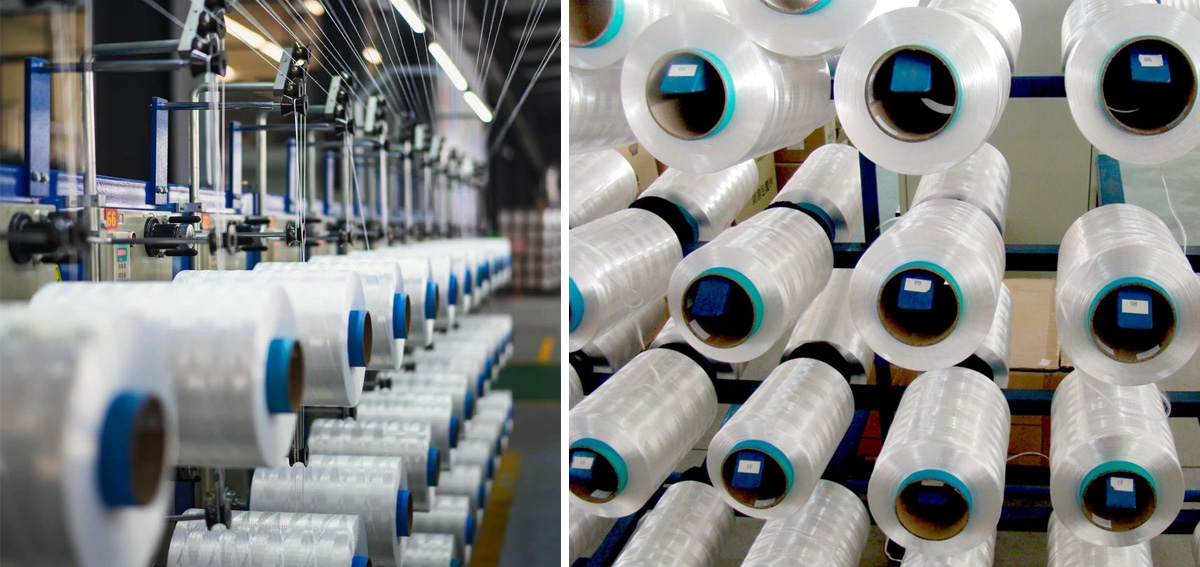
Ultra-high molecular weight polyethylene fiber, also known as high-strength, high-modulus polyethylene fiber, is the fiber with the highest specific strength and specific modulus in the world. It is a fiber spun from polyethylene with a molecular weight of 1 million to 5 million. Ultra-high molecular weight polyethylene fiber mainly has the following characteristics:
1. High specific strength and high specific modulus. Its specific strength is more than ten times that of steel wire of the same cross-section, and its specific modulus is second only to special carbon fiber. Typically, its molecular weight is greater than 10, with a tensile strength of 3.5 GPa, an elastic modulus of 116 GPa, and an elongation of 3.4%.
2. Low density. Its density is generally 0.97~0.98 g/cm³, allowing it to float on water.
3. Low elongation at break. It has a strong energy absorption capacity, excellent impact and cut resistance, excellent weather resistance, and is resistant to ultraviolet rays, neutrons, and gamma rays. It also possesses high specific energy absorption, low dielectric constant, high electromagnetic wave transmittance, and resistance to chemical corrosion, as well as good wear resistance and a long flexural life.
Polyethylene fiber possesses many superior properties, demonstrating a significant advantage in the high-performance fiber market. From mooring lines in offshore oil fields to high-performance lightweight composite materials, it exhibits tremendous advantages in modern warfare, as well as in the aviation, aerospace, and maritime sectors, playing a crucial role in defensive equipment and other areas.
Post time: Dec-22-2025


