


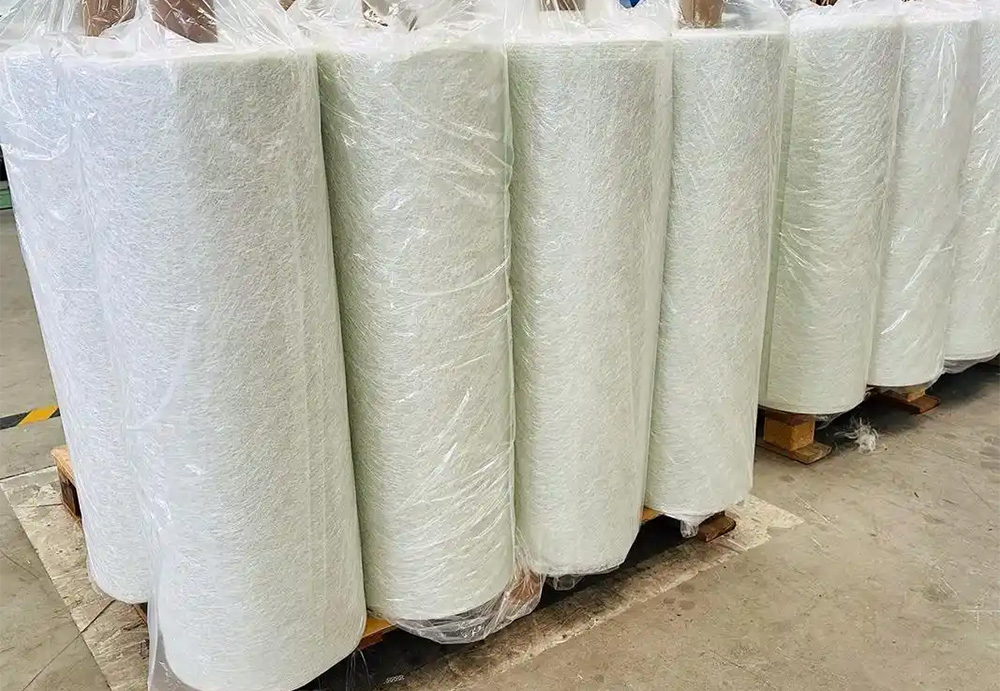
Under the trend of large-scale and offshore wind power blades, the stability, strength and process adaptability of the composite material system directly determine the blade life and power generation efficiency.As the key reinforcing substrate for the blade shell, web, leading edge, trailing edge and other parts, glass fiber chopped felt has become the standard material for VARTM vacuum perfusion, hand paste/molding with good uniformity, fast penetration, excellent moldability, and strong inter-layer binding.Choosing the wrong model and weight, lightness will lead to surface defects and lack of glue in perfusion, and heavyness will affect structural strength and fatigue performance.This paper systematically combs the standard model, core specifications, selection logic, and application matching of chopped felt for wind power blades.
1. Chopped felt for wind power blades: basic positioning and core requirements
-Quality deviation per unit area: ±5%
-Moisture content: ≤0.2%
-Tensile strength: ≥30–180N/5cm (increase with gram weight)
-Permeability: fast soaking, low air bubbles, suitable for vacuum perfusion
-Weather resistance/salt spray resistance: offshore models need to strengthen anti-corrosion adaptation
-Stability: no powder loss, no layering, no hair feathers, suitable for automatic layering
Glass fiber chopped felt mainly assumes the functions of non-main bearing reinforcement, surface homogenization, inter-layer transition, and deformation resistance in the blade. It is used in combination with one-way cloth, multi-axial cloth, continuous felt, and surface felt to form a complete structural layer.
2. List of models and specifications of wind power blade chopped felt
The mainstream models in the industry are EMC (emulsion)/CMC (powder), and the width is commonly used 1250/1040/2500mm. The following are the most commonly used models for blade mass production.:
1) The standard model corresponds to the gram weight
-EMC225: 225g/㎡, thin transition layer, delicate surface
-EMC300: 300g/㎡, universal main force, universal shell/web
-EMC450: 450g/㎡, medium thickness reinforcement, strengthening of the force area
-EMC600: 600g/㎡, thick reinforcement, root/leading edge thickening
-EMC900: 900g/㎡, heavy-duty reinforcement, local strengthening of large blades
2) Selection of binder type
-Emulsion type EMC: high strength, good uniformity, excellent resin compatibility, the first choice for vacuum perfusion
-Powder type CMC: faster soaking, better cost, suitable for hand paste/auxiliary process
-Offshore wind power, high-strength blades: priority EMC emulsion series
3) Width and process matching
-1250mm/1040mm: medium and small blades, manual layering
- 2500mm and above: large blades, automatic layering, reduce lap
3. Selection by part: how to match different areas of the blades?
1) The outer surface of the shell/the lower layer of the gel coat
-Recommended: EMC225 / EMC300
-Key points: smooth surface, reduce pinholes, improve appearance and weather resistance
2) The main layer of the shell (transition/equilibrium layer)
-Recommended: EMC300
-Key points: the balance of strength and penetration, the best match with multi-axial cloth
3) Reinforcement of the sides of the web and beam cap
-Recommended: EMC450
-Key points: higher stiffness, shear resistance, and improved structural stability
4) Leading edge, trailing edge, root thickening area
-Recommended: EMC600 / EMC900
-Key points: rapid forming of thick layers, reducing the number of layers, and improving impact resistance
5) Offshore wind power blades (salt spray/high humidity)
-Recommended: low hair feather EMC300/450 + hydrolysis-resistant wetting agent
-Key points: improve aging resistance and reduce the risk of stratification
Post time: Apr-22-2026


