


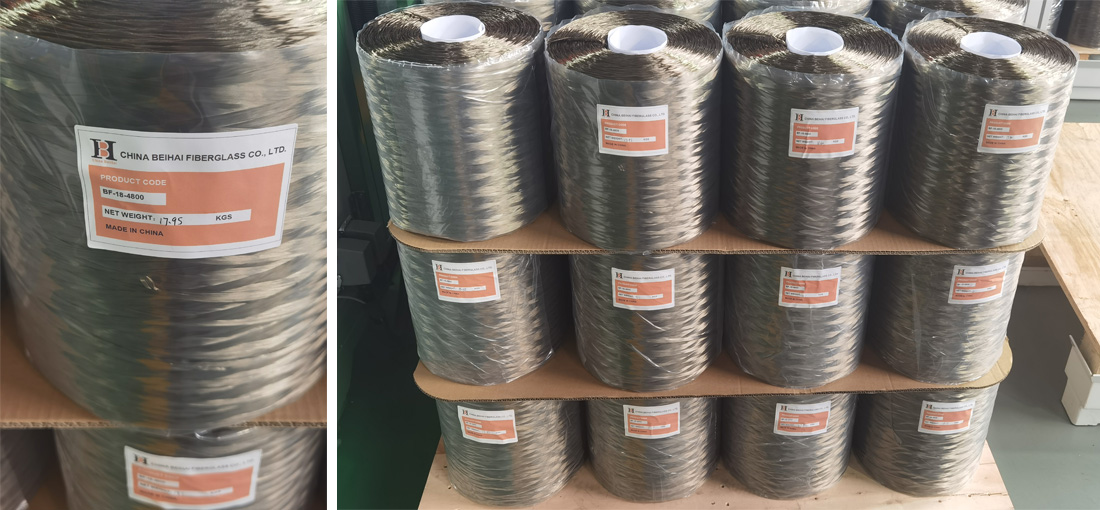
Basalt fiber roving (typically referring to untwisted roving) is one of the key raw materials used in the manufacture of basalt fiber composite reinforcement (hereinafter referred to as basalt composite reinforcement). According to the latest publicly available information, its applications, manufacturing processes, and performance advantages are as follows:
Definition and Applications of Basalt Composite Reinforcement
Basalt fiber composite reinforcement is a type of non-metallic composite reinforcement manufactured using basalt fiber as the reinforcing material and resin (such as epoxy resin or unsaturated polyester) as the matrix, through processes such as pultrusion, winding, or curing.
It is primarily used in civil engineering to replace traditional steel reinforcement, such as in concrete structure reinforcement, bridges, roads, and marine engineering, offering advantages including corrosion resistance, light weight, high strength, non-magnetic properties, and electrical insulation.
The Role of Basalt Fiber Roving in Composite Reinforcement
Reinforcement: Untwisted roving consists of multiple parallel filaments bundled together, providing uniform tension. It is suitable for forming processes such as pultrusion and winding, effectively enhancing the tensile strength and elastic modulus of the composite reinforcement.
Process Compatibility: According to the national standard GB/T 25045-2025, untwisted rovings (suitable for processes such as pultrusion and winding) must have a breaking strength of ≥ 0.45 N/tex and a tensile strength of ≥ 2500 MPa after resin impregnation, thereby meeting the high-strength requirements of composite reinforcement.
Surface Treatment: To enhance interfacial adhesion with the resin, roving is typically treated with a surface treatment agent (such as a coupling agent) before resin impregnation.
Typical Preparation Process Flow
- Fiber Preparation: Select standard-compliant basalt fiber roving (single-fiber diameter generally 7–13 μm).
- Surface Treatment: Coat or impregnate with a specialized coupling agent to improve fiber-resin interfacial adhesion.
- Resin Impregnation: Pass the roving through a resin bath to fully saturate it with thermosetting resin (such as epoxy or vinyl ester).
- Molding and Curing: Feed the roving into a pultrusion die and cure it under heat to form a stiffener with the desired cross-sectional shape.
- Post-processing: Cut, inspect, and package the material to produce the finished composite stiffener.
Post time: Apr-14-2026


