


When discussing the core substrate of copper-clad laminates (CCLs), electronic fiberglass cloth is often broadly referred to simply as “fiberglass cloth.” Recently, many purchasing managers and engineers have asked: Are T-glass, Q-glass, and low-Dk fabrics all considered high-end electronic glass fabrics? What exactly are low-end electronic fabrics on the market, and where do the core differences lie?
Today, we break down these concepts clearly to help you understand the market positioning, performance parameters, and application scenarios of various electronic fiberglass cloths, serving as a practical reference for material selection and supply chain evaluation.
The Quick Takeaway: T-glass, Q-glass, and low-Dk fabrics are all functional, high-end specialty electronic glass fabrics, but their targeted technical directions differ completely. Standard E-glass fabric remains the industry’s most typical general-purpose low-to-mid-end electronic fabric.
I. What Do Various High-End Electronic Fabrics Do?
Electronic glass cloth acts as the “steel reinforcement skeleton” inside copper-clad laminates. Once impregnated with resin, it determines the mechanical strength, thermal stability, and signal transmission performance of PCB substrates. The upgrade pathways and pain points solved by the three major high-end fabrics vary significantly.
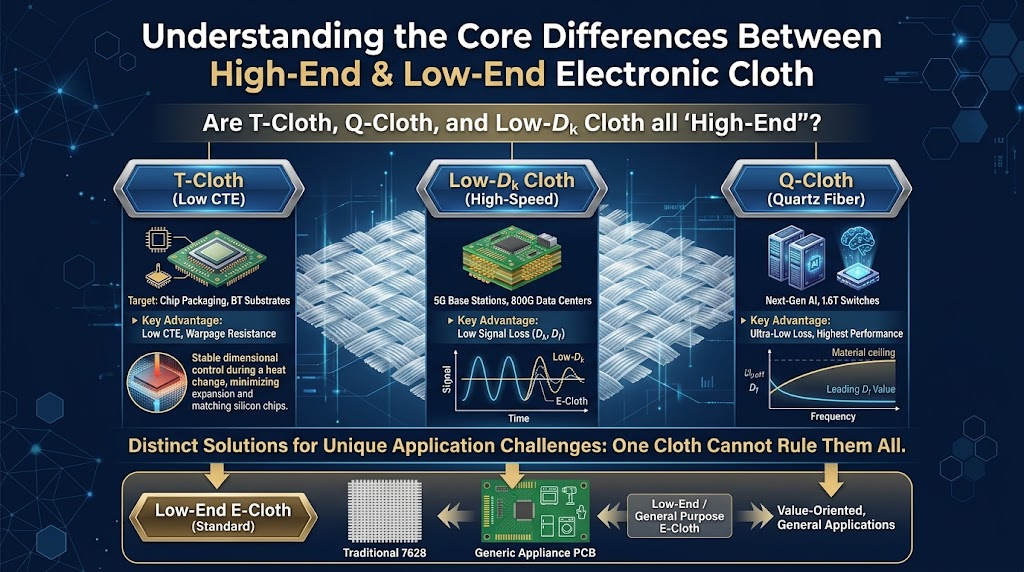
1. T-Glass (Low-CTE Fabric)
- Core Specialty: Low thermal expansion and anti-warpage performance.
- Mechanism: T-glass does not focus on ultra-low dielectric loss. Instead, its core metric is an extremely low coefficient of thermal expansion (CTE). During chip packaging, temperature fluctuations are severe. If the substrate expands and contracts unevenly under heat, it easily leads to substrate warpage and solder joint failure. T-glass is specifically engineered to solve this “thermal mismatch” problem.
- Key Applications: IC substrates, BT resin substrates, FC-BGA advanced packaging substrates, and core base materials for AI chip packaging.
- Core Value: Matches the thermal expansion coefficient of silicon chips as closely as possible to ensure high packaging yield and long-term reliability.
- Industry Landscape: Dominated by overseas players like Nitto Boseki (Nittobo), with domestic manufacturers accelerating sample introduction and small-batch validation.
2. Low-Dk Fabric (Low Dielectric Constant Fabric / 2nd Generation High-Speed Glass Fabric)
- Core Specialty: Reducing signal transmission loss for high-speed communications.
- Mechanism: Standard E-glass exhibits relatively high dielectric loss. As signal speeds increase, signal attenuation becomes severe and noise amplifies. Low-Dk fabrics optimize glass formulations to dramatically lower dielectric constant (D_k) and dissipation factor (D_f) values, ensuring the integrity of high-speed signals.
- Key Applications: 5G base stations, 800G optical transceiver modules, conventional AI server motherboards, high-speed switches, and mainstream base materials for M7/M8 grade CCLs.
- Core Value: The largest volume high-end fiberglass category currently used in 224Gbps and below high-speed PCBs and computing hardware.
- Industry Landscape: Domestic localization is progressing relatively quickly, with mass production already underway, though supply-demand gaps persist.
3. Q-Glass (Quartz Fabric / 3rd Generation Ultra-High-Speed Electronic Fabric)
- Core Specialty: Ultimate low loss, serving as a next-generation computing hardware material.
- Mechanism: The raw material for Q-glass is no longer traditional glass, but high-purity quartz fiber. Its performance achieves a quantum leap, pushing D_k and D_f to the absolute ceiling of existing fiberglass materials.
- Key Applications: 1.6T network switches, CPO (Co-Packaged Optics), next-generation AI servers utilizing the Rubin architecture, and ultra-high-frequency, high-speed circuit boards.
- Current Status: Largely in the validation and small-batch ramp-up phase, characterized by tight production capacity and high costs.
- Industry Landscape: Features the highest technological barriers, with overseas leaders holding a clear first-mover advantage while domestic makers are still breaking through key bottlenecks.
Summary of the Three High-End Roles:
- T-Glass: Prevents deformation; essential for packaging substrates.
- Low-Dk Fabric: Reduces signal loss; current mainstay for AI servers.
- Q-Glass: Ultimate performance; reserve material for next-generation ultra-high-speed hardware.
II. What Exactly is Low-End Electronic Fabric? (Standard E-Glass)
The low-end electronic fabric we frequently mention primarily refers to standard E-glass fabric, featuring common styles such as 7628, 2116, and 1080. It represents the foundational and highest-volume electronic glass cloth category in the CCL industry.
Basic Characteristics:
- Mature Formulation & Simple Process: Mass-produced by numerous factories globally with abundant production capacity.
- Standard Parameters:D_k, D_f, and thermal expansion properties are ordinary without special optimization.
- Low Cost & High Versatility: Offers outstanding cost-effectiveness for general applications.
Downstream Application Scenarios:
Home appliance circuit boards, general consumer electronics, power supply boards, industrial control standard PCBs, and low-end multilayer boards—essentially universal scenarios that do not demand ultra-high transmission rates or rigorous thermal stability.
Note: Price differences between high-end and low-end fabrics can reach tens of times. This gap stems fundamentally not from weaving craftsmanship differences, but from completely different dimensions of glass substrate formulations, raw material purity, and the overall manufacturing process barrier.
III. Procurement & Material Selection Pitfalls to Avoid
- Do Not Broadly Assume “High-End Fabric Can Handle All Scenarios”: While T-glass offers excellent thermal stability, its dielectric performance is average; using it for high-speed server motherboards is not cost-effective. Conversely, low-Dk fabric delivers exceptional signal transmission, but its CTE parameters fall short of advanced packaging substrate standards. They cannot replace each other arbitrarily.
- High-End Does Not Automatically Mean Blind Localization: Low-Dk fabrics have achieved solid domestic maturity; however, many T-glass and Q-glass projects are still undergoing strict validation cycles. Switching suppliers requires thorough reliability testing.
- Projects Do Not Need to Mindlessly Adopt Q-Glass Just Because They Are Advanced: For GB200 and existing 800G hardware, modified low-Dk fabrics can easily meet demands at this stage. Q-glass belongs to the next-generation upgrade roadmap; introduce it strictly on an as-needed basis to avoid over-design that artificially inflates material costs.
Post time: Oct-10-2026


