

Many of my colleagues have had similar experiences where we used to think of fiberglass as being a traditional material, it simply laid bricks and served functional purposes as reinforcement in building structures or being used as a structural component in creating boat hulls. It really is amazing how things can change so much so fast! The two hottest industries in 2026, flying cars (eVTOLs) and artificial intelligence computing servers, will both rely on thin strands of fiberglass to “save the day”!
To put it straightforwardly, fiberglass has been changing rapidly – from being used largely industrially to becoming a strategic asset.
1. Flying cars – why carbon fibre did not represent the best option
The knee – jerk reaction when most individuals think of evtols (electric vertical take-off and landing) is to associate them with high-tech and consider carbon fibre as the end-all be-all of high technology. Although carbon fibre is generally considered to be a premium, high-tech material; fibreglass will actually constitute the great “silent heavyweight” when it comes time for the manufacturers of evtols to commercialise and reach a mass-market scale
What makes carbon fibre very good is also what makes it costly. Because if the cost of making any sort of Vehicle will be costly, it will take time for the consumers to get most of it in the way we use Ubers. A low-cost material like fibreglass with its capability to be used just as well as carbon fibres for many parts like airframe, cabin and headers; in fact, it is very easy to process it as compared to carbon fibre.
There is the issue of signal transmission. This is a critical point that many laypeople tend to overlook. Carbon fiber is electrically conductive, which creates a shielding effect that blocks signals. However, eVTOLs operate in the skies, relying heavily on GPS, radar, and satellite communications; if the aircraft’s nose cone were made of carbon fiber, signal transmission would be completely cut off. In this scenario, fiberglass—with its exceptional radio-transparent properties—becomes the only viable choice. Without it, a flying car would be like a “crayfish”—possessing plenty of power, but completely blind.
2. AI computing power is the steel reinforcement of PCBs.
If low-altitude economies create an expansion of the physical world, then artificial intelligence is the foundation of the digital world. Modern servers built for artificial intelligence (AI), such as those running large language models or performing deep learning tasks, are based on high-density printed circuit boards (PCBs).
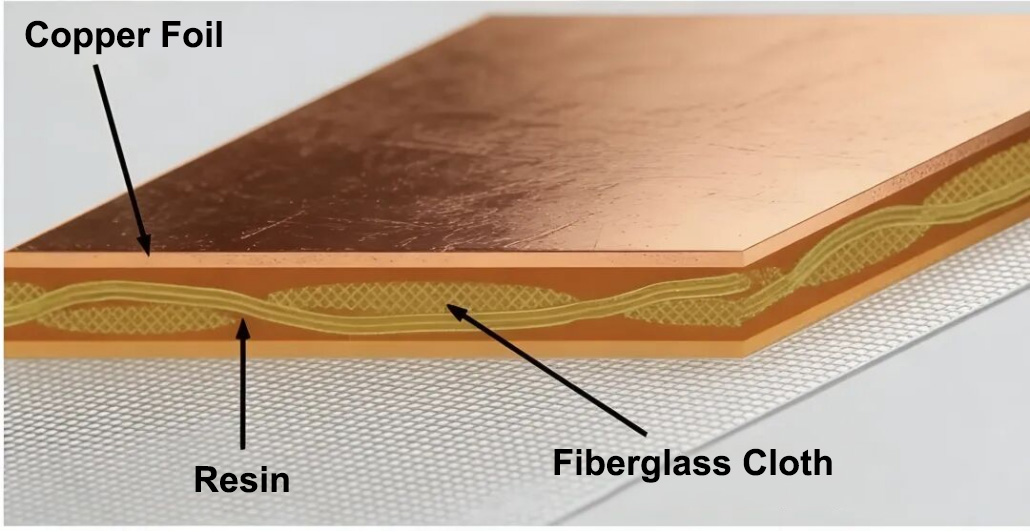
One of the key components that enables this new technology is a type of fiberglass fabric called electronic grade fiberglass cloth. It acts as nerve-removal for copper clad laminates (CCLs) and can be likened to steel rebar used in constructing reinforced concrete. Modern artificial intelligence (AI) chips and advanced computers require the transmission of signals at virtually extreme levels. In order to meet these requirements for rapid signal transfer in conjunction with low heat generation/distortion, the fiberglass cloth used as the supporting matrix for the CCL must be extremely thin and have a very low dielectric constant. High-performance electronic grade glass fibers now exist that are only a few microns wide, much finer than human hairs. If these very high quality electronic grade glass fibers were not available to manufacture CCL hardware, then the computing capacity of the AI servers would essentially be “constrained” by their hardware
AI Cluster Computing Data Center and Flying Car Sky are two examples of how Fiberglass is quietly becoming more and more integrated into the most advanced hardware equipment in the world today. Glass Reinforced Plastic no longer exists as a low cost alternative; it is now a critical part of the “New Quality Productive Forces”.
Post time: Mar-31-2026


