

For many years, steel reinforcement has been a highly favored basic building material in the construction industry. However, a large amount of actual engineering data shows that if the reinforced concrete structure is poorly designed or the on-site environment is harsh, the durability and performance of the steel reinforcement will be affected. Many Chinese and foreign scholars have concluded that using glass fiber composite reinforcement to replace steel reinforcement in specific fields is an effective way to solve this problem. Glass fiber composite reinforcement is a new type of composite material formed by pultrusion and special surface treatment, using glass fiber filaments as reinforcement, epoxy resin as the matrix material, and incorporating appropriate auxiliary agents (such as crosslinking monomers, initiators, accelerators, alteration agents, flame retardants, polymerization inhibitors, fillers, pigments, etc.).
1. Characteristics of Glass Fiber Composite Reinforcement
(1) High Tensile Strength: The tensile strength of glass fiber reinforcement is superior to that of ordinary steel reinforcement, exceeding that of steel reinforcement of the same specification by 20%, and it also has good fatigue resistance.
(2) Lightweight: The weight of glass fiber reinforcement is only 1/4 of that of steel reinforcement of the same volume, with a density between 1.5 and 1.9 (g/cm3). (3) Strong corrosion resistance: Resistant to corrosion from acids, alkalis, and other chemicals; resists erosion by chloride ions and low-pH solutions, especially strong resistance to carbon compounds and chlorine compounds.
(3) Strong material bonding: The coefficient of thermal expansion of glass fiber reinforced concrete is closer to that of cement than that of steel, resulting in a stronger bond between the glass fiber reinforced concrete and the concrete.
(4) High design flexibility: Glass fiber reinforced concrete has a stable elastic modulus and stable dimensions under thermal stress. It can be bent and formed into any shape, has good safety performance, is non-conductive, non-electrical, flame-retardant, and anti-static. With changes in the formula, it will not generate sparks when colliding with metals.
(6) Strong magnetic permeability: Glass fiber reinforced concrete is a non-magnetic material, eliminating the need for demagnetization treatment in non-magnetic or electromagnetic concrete components.
(7) Convenient construction: Glass fiber reinforced concrete can be manufactured in various standard and non-standard parts with different cross-sections and lengths according to user requirements. On-site binding can be done using non-metallic tensioning straps, making the operation simple.
|
Name |
Glass Fiber Composite Reinforced Bar |
Steel Bar |
|
Density(g/cm3) |
1.5-1.9 |
7.8-7.9 |
|
Tensile Strength(MPa) |
≥600 |
≥500 |
|
Yield Strength(MPa) |
≥600 |
≥300 |
|
Compressive Strength(MPa) |
≥500 |
- |
|
Modulus of Elasticity(GPa) |
≥40 |
210 |
|
Elongation(%) |
≥1.5 |
≥1.8 |
Glass fiber composite reinforcement exhibits extremely strong corrosion resistance, especially with high tolerance to pH solutions and corrosive substances. Whether in exposed, rain-soaked areas or humid environments, fiberglass composite reinforcement exhibits good corrosion resistance in agriculture and generally has a longer service life than traditional steel reinforcement.
2. Application of Fiberglass Composite Reinforcement in Agriculture
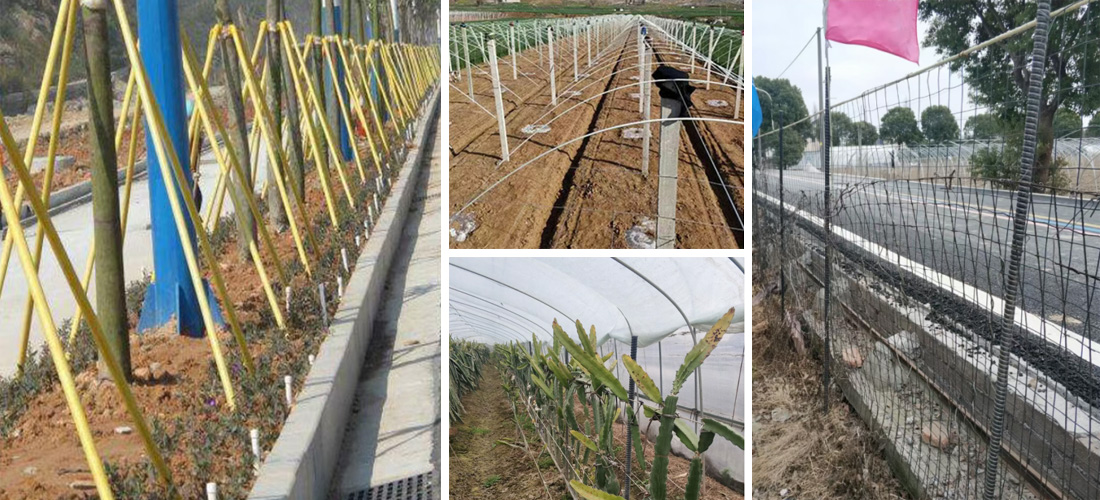
(1) Anti-theft fencing has long been widely used in agriculture. Conventional fencing uses steel reinforcement as support rods, but prolonged outdoor use leads to corrosion and failure of the steel reinforcement. The strong corrosion resistance of fiberglass composite reinforcement makes it very suitable as a replacement for steel reinforcement as support rods.
(2) Providing support for trees during their growth is essential. Conventional support rods are mainly made of wood and steel, but corrosion and aging occur during long-term use, rendering the support rods ineffective in harsh weather conditions. Fiberglass composite reinforcement is not only lightweight and high-strength but also has good corrosion resistance, making it a very suitable product to replace wood and steel support rods.
(3) The support frames for agricultural greenhouses have traditionally been made of wood and steel. Due to the high temperature and humidity of the environment, the support frames made of wood and steel will age and corrode, posing safety hazards. Fiberglass composite reinforcement can be designed and manufactured into support frames of different models and specifications according to usage requirements. It can be directly installed on-site, is lightweight, and very convenient to construct; the material itself is also corrosion-resistant and anti-aging. Considering both safety and economy, fiberglass composite reinforcement is very suitable as a greenhouse support structure.
(4) During the growth of fruits and vegetables, support frames are essential for their better growth. Conventional support frames are mainly made of wood and steel, but due to their low strength, they are prone to aging and corrosion in humid environments. Once the fruits and vegetables mature and reach a certain weight, the support frames may collapse. Fiberglass composite reinforcement has the characteristics of being lightweight, high-strength, and corrosion-resistant, making it very suitable to replace wood and steel as support frames for fruits and vegetables.
3. Conclusion Fiberglass composite reinforcement combines the excellent mechanical, physical, and chemical properties of epoxy resin and fiberglass, and is widely used to solve the corrosion problem of steel in special usage environments. Its good cost-effectiveness, simple construction, and excellent corrosion resistance have led it to gradually replace steel and occupy a place in the agricultural field, playing an important role in the development of the national economy.
Post time: Dec-25-2025


