

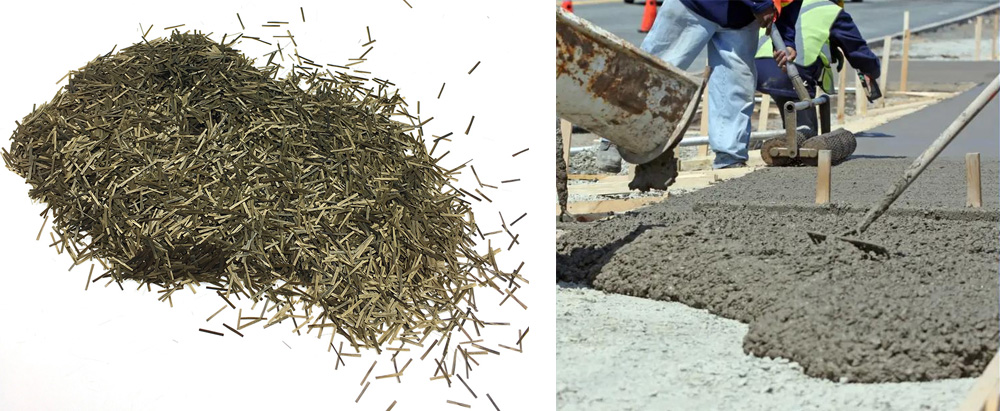
Chopped basalt fibers are inorganic mineral fibers with lengths typically less than 50 mm, produced by chopping basalt fibers as the base material. They can be uniformly dispersed in concrete. Based on their application, they are primarily categorized as: crack-resistant fibers for concrete (BF), toughening and reinforcing fibers (BZ), and crack-resistant fibers for mortar (BSF).
Properties of Chopped Basalt Fiber
Chopped basalt fiber exhibits outstanding high strength and high modulus properties, with tensile strength reaching 1050-1250 MPa and elastic modulus not less than 34 GPa. It demonstrates exceptional high-temperature resistance, capable of continuous operation across a wide temperature range from -269°C to 650°C. They exhibit high corrosion resistance and chemical stability in acidic, alkaline, and saline corrosive media. Particularly in saturated alkali solutions and cement-based alkaline environments, their monofilament tensile strength retention rate exceeds 75%, demonstrating outstanding alkali resistance. Chopped basalt fibers exhibit excellent compatibility with inorganic binders, with a moisture absorption rate below 1% that remains stable over time. This demonstrates their superior material stability, longevity, and environmental compatibility during use. Additionally, these fibers possess outstanding insulation properties, high-temperature filtration capabilities, radiation resistance, and wave permeability.
Analysis of Chopped Basalt Fiber Application in Concrete
Chopped basalt fiber-reinforced concrete involves incorporating a specific quantity of continuous or discontinuous chopped basalt fibers into concrete through appropriate methods. This approach significantly enhances concrete’s toughness and tensile strength while preserving its inherent compressive strength, thereby effectively reinforcing concrete and extending the service life of engineering structures.
Beyond basalt fibers, materials like carbon fiber, glass fiber, and aramid fiber have also been used as reinforcements in concrete. However, long-term practice indicates these materials present challenges when applied to concrete, often failing to meet market demands for high-performance concrete. The emergence of chopped basalt fibers fills this gap both materially and methodologically, significantly advancing concrete reinforcement technology. Its role in concrete reinforcement is primarily manifested in the following aspects:
1. Effective Crack Suppression: Leveraging their abundance and surface area advantage, chopped basalt fibers effectively constrain microcracks, preventing their propagation and connection. Simultaneously, they overcome the shortcomings of other synthetic fibers—such as low density, tensile strength, and elastic modulus—by resisting breakage during crack expansion. This significantly inhibits microcrack development and delays new crack formation, positively enhancing concrete’s water resistance and freeze-thaw durability.
2. Combining High Modulus with Construction Convenience: Chopped basalt fibers leverage the high modulus and high tensile strength per filament similar to steel fibers to inhibit crack propagation. They also effectively overcome the drawbacks of steel fibers, such as tendency to clump during mixing, which hinders pumping and construction.
3. Excellent Dispersibility and Compatibility: As silicate-based inorganic fibers, chopped basalt fibers exhibit inherent compatibility with cementitious materials. Their density (approximately 2.63–2.80 g/cm³) is comparable to cement concrete and mortar, ensuring good workability and uniform dispersion within concrete structures after incorporation.
4. Superior Durability: Surface-modified chopped basalt fibers exhibit “inert fiber” characteristics, demonstrating exceptional resistance to high temperatures, corrosion, and impact. They maintain stability even in high-temperature, highly corrosive environments while enhancing the cement matrix’s deformation resistance. Consequently, they withstand the harsh conditions throughout concrete mixing, pouring, setting, and service phases, significantly improving concrete durability.
In summary, chopped basalt fibers effectively enhance concrete’s impact resistance, reduce brittleness, and comprehensively improve its mechanical properties. Specifically, within concrete structures, they function to inhibit cracking, prevent seepage, enhance durability, increase impact and tensile strength, and contribute to improved surface quality.
Construction Methods and Precautions for Chopped Basalt Fiber Concrete
1. Construction Temperature
Chopped basalt fiber concrete should be applied under temperatures ranging from -5°C to 25°C. Excessively high or low temperatures may result in uneven mixing.
2. Construction Quality Control
Quality control for chopped basalt fiber concrete construction should focus on raw material inspection, measurement accuracy, and mixing process quality.
2.1 Mix Design
During actual construction, select different chopped basalt fiber content levels within reasonable ranges based on project requirements. Since chopped basalt fiber does not chemically react with other concrete components or admixtures, its dosage typically does not alter the original mix design principles. Throughout construction, the quantities of all materials must be strictly calculated and determined according to the construction mix design and batch size.
2.2 Addition Sequence and Method
During mixing, chopped basalt fibers should be added simultaneously with aggregates such as sand and stone. It is recommended to evenly distribute the fibers into the aggregate mixture during their addition, followed by water addition for wet mixing.
Fiber addition methods can be categorized as manual or automatic:
Manual Addition: After hot aggregates are loaded into the mixer drum, pre-weighed basalt fibers are manually added. This method involves higher labor intensity and relatively lower mixing uniformity. Mixing time should be appropriately extended based on actual conditions to ensure even fiber dispersion.
Automatic Feeding: Use a basalt fiber feeder for automatic metering, synchronized with the hot aggregate feeding into the mixer drum. Fiber feeders typically feature automatic metering, pre-dispersal, and pneumatic delivery mechanisms, offering advantages of convenience, speed, and accuracy. The appropriate method should be selected based on actual construction conditions.
2.3 Slump Adjustment
Fiber addition slightly increases concrete mixture viscosity, affecting slump. If slump fails to meet construction requirements, prioritize adjustment using plasticizers or water-reducing agents; avoid increasing water content.
2.4 Placement and Curing
Concrete incorporating chopped basalt fibers requires no special placement procedures, but thorough compaction must be ensured. Curing requirements are identical to those for standard concrete.
Post time: Feb-27-2026


