


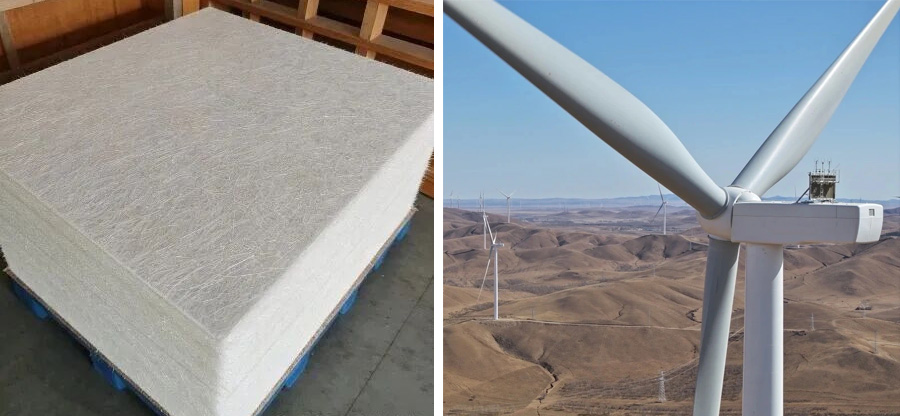
With the trend toward larger and offshore wind turbine blades, the stability, strength, and process compatibility of composite material systems directly determine blade lifespan and power generation efficiency. As a key reinforcing substrate for blade shells, webs, leading edges, trailing edges, and other components, chopped strand mat (CSM) has become the standard material for VARTM vacuum infusion and hand lay-up/compression molding due to its excellent uniformity, rapid impregnation, superior moldability, and strong interlaminar bonding. Incorrect selection of grade or weight can result in minor issues like surface defects or resin voids during infusion, or more severely compromise structural strength and fatigue performance. This paper systematically outlines standard grades, core specifications, selection logic, and application compatibility for chopped strand mats used in wind turbine blades.
Chopped Strand Mat for Wind Turbine Blades: Foundational Positioning and Core Requirements
Wind turbine blade chopped strand mats uniformly employ alkali-free E-glass fibers with diameters of 9–13μm and chopped lengths of 12–25mm, meeting GB/T 17470 standards and compatible with epoxy/vinyl ester resin systems.
Key Performance Thresholds
- Area weight deviation: ±5%
- Moisture content: ≤0.2%
- Tensile strength: ≥30–180 N/5 cm (increases with basis weight)
- Impregnability: Rapid saturation, low bubbling, suitable for vacuum infusion
- Weather/salt spray resistance: Enhanced corrosion protection required for offshore models
- Stability: No powder shedding, no delamination, no fuzz; suitable for automated layup
Chopped strand mat primarily serves non-primary load-bearing reinforcement, surface uniformity, interlayer transition, and deformation resistance in blades. It forms a complete structural layer when combined with unidirectional fabrics, multi-axial fabrics, continuous mats, and surface mats.
Wind Turbine Blade Chopped Strand Mat Models and Specifications
Industry-standard models include EMC (emulsion)/CMC (powder) types with common widths of 1250/1040/2500 mm. Below are the most widely used models for blade mass production:
1) Standard Models and Corresponding Grammages
- EMC225/CMC225: 225g/m², thin transition layer with fine surface finish
- EMC300/CMC300: 300 g/m², versatile mainstay for both shell and web applications
- EMC450/CMC450: 450 g/m², medium-thickness reinforcement for load-bearing zones
- EMC600/CMC600: 600 g/m², thick reinforcement for root/leading edge thickening
- EMC900: 900 g/m², heavy-duty reinforcement for localized strengthening of large blades
2) Adhesive Type Selection
- Emulsion-based EMC: High strength, excellent uniformity, superior resin compatibility; preferred for vacuum infusion
- Powder-based CMC: Faster penetration, cost-effective, suitable for hand lay-up/auxiliary processes
- Offshore wind power, high-strength blades: Prioritize EMC emulsion series
3) Web Width and Process Matching
- 1250mm/1040mm: Small-to-medium blades, manual lay-up
- 2500mm and above: Large blades, automated layup, reduced overlaps
Selection by Component: How to Match Different Blade Areas?
1) Outer Shell Surface/Glassing Undercoat
- Recommended: EMC225 / EMC300
- Key Points: Surface smoothness, reduced pinholes, enhanced appearance and weather resistance
2) Main Shell Layer (Transition/Balance Layer)
- Recommended: EMC300
- Key points: Balanced strength and impregnation, optimal with multi-axial fabrics
3) Web, beam cap side reinforcement
- Recommended: EMC450
- Key points: Higher stiffness, shear resistance, improved structural stability
4) Leading edge, trailing edge, root thickening zones
- Recommended: EMC600 / EMC900
- Key points: Rapid thick-layer molding, reduced ply count, improved impact resistance
5) Offshore wind turbine blades (salt spray/high humidity)
- Recommended: Low-fuzz EMC300/450 + hydrolytic-resistant impregnant
- Key points: Enhanced aging resistance, reduced delamination risk
Chopped strand mat vs. other fiberglass mats: Why is it preferred for blades?
1) Chopped Strand Mat vs. Continuous Filament Mat
- Chopped Strand Mat: Isotropic, excellent mold coverage, suitable for curved surfaces and infusion
- Continuous Mat: Higher longitudinal strength, slightly lower uniformity
- Blade Assembly: Chopped strand for main body, continuous/unidirectional fabric for primary load-bearing zones
2) Chopped Strand Mat vs. Needle-Punched Mat
- Needle-punch mats: Higher strength, higher cost
- Chopped strand mats: Process-friendly, cost-effective, fewer defects
- Selection: Chopped strand more stable and economical for non-load-bearing zones
3) Chopped Strand Mat vs. Surface Mat
- Surface Mat: 30–120 g/m², solely for aesthetic sealing
- Chopped Strand Mat: Dual function of structural reinforcement + surface uniformity
- Combination: Surface mat + chopped strand mat + multi-axial fabric constitutes standard blade layup
5-Step Selection Method
1. Consider Process: Vacuum infusion → Select EMC emulsion; Hand lay-up → Opt for CMC powder
2. Consider Location: Curved surfaces/exterior → 225/300g; Reinforcement → 450/600g; Heavy-duty → 900g
3. Resin Considerations: Epoxy systems → Verify impregnant compatibility; Marine applications → Hydrolysis-resistant types
4. Web Width: Use wide webs for large blades to minimize overlaps and defects
5. Quality Standards: Grammage deviation ≤±5%, Moisture content ≤0.2%, No powder shedding or fuzz
Common Pitfalls and Avoidance Strategies
- Focusing solely on price without considering the binder: Powder mats used in infusion may cause uneven penetration
- Arbitrarily increasing weight: Excessive thickness can lead to incomplete infusion and interlayer defects
- Neglecting width and overlaps: Excessive overlaps increase the risk of bubbles and dry spots
- Using the same material for marine and land applications: Marine use requires specialized hydrolysis-resistant/low-fuzz grades
Post time: Mar-05-2026


