


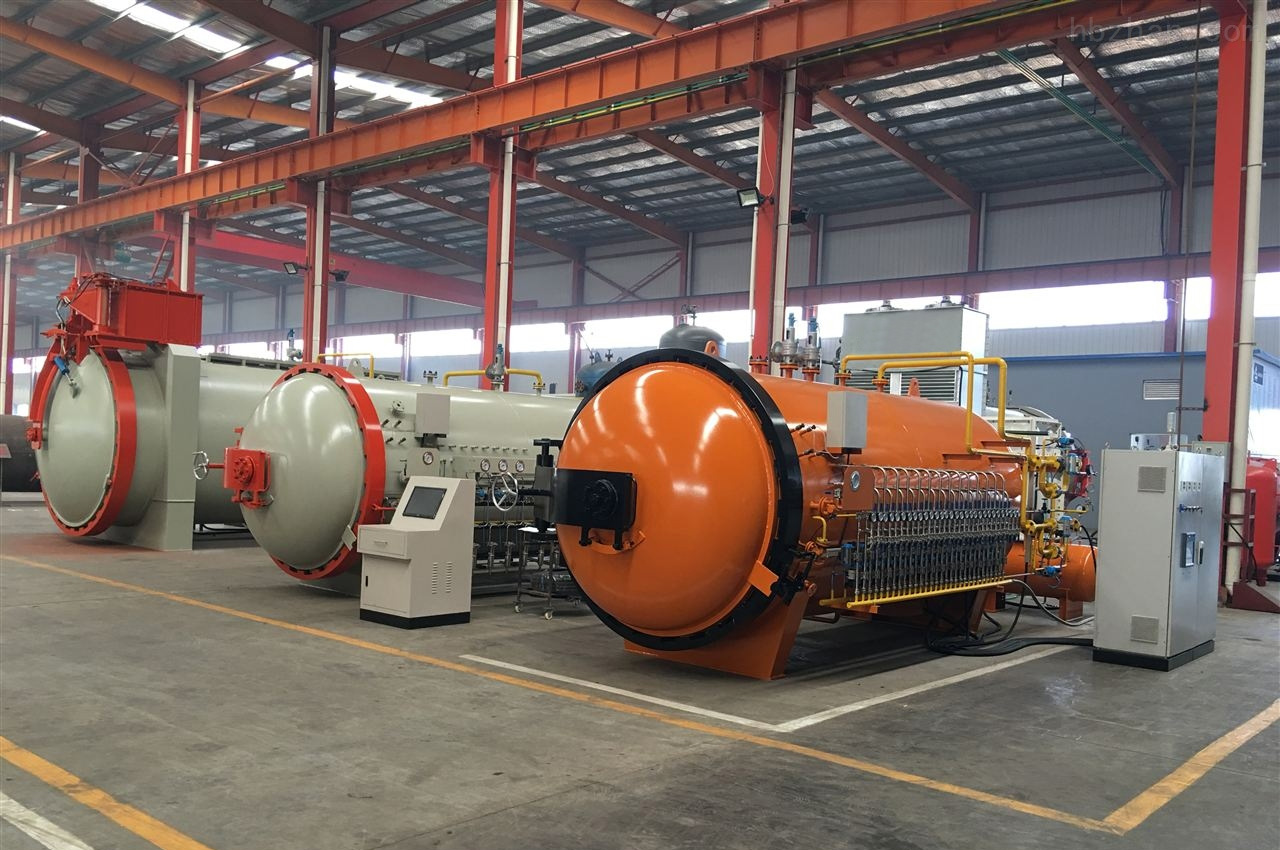
The autoclave process involves laying up prepregs according to layup specifications within a mold, sealing them in a vacuum bag, and then placing the assembly into an autoclave. Through heating and pressurization within the autoclave equipment, the material undergoes a curing reaction, transforming the prepreg blank into the desired shape while meeting the quality requirements for the component.
Advantages of the autoclave process:
Uniform pressure distribution within the tank: Pressurization using compressed air, inert gases (N₂, CO₂), or mixed gases ensures equal pressure applied to all points along the normal lines of the vacuum bag surface. This enables uniform pressure during component forming and curing.
Uniform air temperature inside the tank: Heating (or cooling) gas circulates rapidly within the tank, maintaining consistent gas temperatures at all points. With a well-designed mold structure, this ensures minimal temperature differentials across the component during heating and cooling cycles while sealed within the mold.
Wide applicability: The relatively simple mold design enables high efficiency, making it suitable for forming large-area complex surfaces such as skins, panels, and shells. It can produce various intricate structures and components of different dimensions. The temperature and pressure conditions within the autoclave can meet the forming requirements of nearly all polymer matrix composite materials.
Stable and reliable forming process: Uniform pressure and temperature within the autoclave ensure consistent part quality. Components manufactured via autoclave process exhibit low porosity and uniform resin content. Compared to other forming methods, parts produced by autoclave offer stable and reliable mechanical properties. To date, the vast majority of high-load composite parts in aerospace applications are fabricated using the autoclave process.
Disadvantages of the autoclave process:
High investment and cost: Compared to other processes, autoclave systems are large, structurally complex, and classified as pressure vessels, making the construction of a large autoclave extremely costly. Each cure cycle consumes significant quantities of expensive auxiliary materials such as vacuum bags, sealing gaskets, release films, permeable mats, and release fabrics. Additionally, the process consumes substantial amounts of water, electricity, and gas.
Primary Applications of Autoclave Process:
Aerospace: Skin panels, ribs, frames, fairings, etc.
Automotive: Body panels and structural components such as inner/outer hood panels, inner/outer door panels, roof panels, fenders, sill beams, B-pillars, etc.
Rail transportation: sleepers, stringers, etc.;
Marine industry, high-end consumer goods, etc.
The autoclave process is the primary method for manufacturing continuous fiber-reinforced composite components. Widely adopted in high-tech sectors such as aerospace, rail transportation, sports and leisure, and new energy, composite products produced via autoclave account for over 50% of total composite output. In the aerospace sector alone, this proportion exceeds 80%.
Vacuum Auxiliary Materials for Autoclaves
Vacuum Bag Film
Vacuum bag film serves as a process auxiliary material for curing composite components. This film material can form and maintain a vacuum state under specific environmental conditions. Its function is to establish a vacuum system.
Release cloth is commonly used as the primary barrier between the product and other vacuum auxiliary materials. It does not adhere to the product and can be easily peeled off after curing, withstanding temperatures up to approximately 230°C.
PTFE High-Temperature Fabric Premium glass fiber is woven into advanced glass fiber fabric substrates using plain, twill, satin, or other weaves. These substrates undergo unique processing techniques involving repeated, thorough impregnation with suspended PTFE emulsion to produce high-temperature fabrics in various thicknesses and multiple super-wide widths.
Separation Film
In most cases, the separation film comes into direct contact with the laminate, isolating it from the non-release breathable felt. The choice of separation film depends on curing temperature, pressure, part complexity, and resin system. Perforated separation films are typically used to ensure the removal of air and volatiles trapped within the laminate.
Perforated Felt
The needle-punching process ensures strict control, uniform surface density, and appropriate thickness. 100% metal detection throughout the process guarantees no metal needle fragments. It offers excellent strength, pressure resistance, temperature resistance, and conformability.
Used in autoclave processes, it has a softening point of 170°C and a melting point above 240°C, capable of withstanding short-term temperatures below 200°C.
Sealing Tape
Sealing tape is used for sealing vacuum bags and molded parts. It must possess sufficient adhesion to bond well to mold surfaces without being overly sticky, ensuring the tape can be peeled off vacuum bag films for repositioning. Additionally, after curing, the tape must peel cleanly from mold surfaces. We offer a range of sealing tapes for different curing conditions.
Vacuum Tubing
Vacuum tubing includes vacuum bases, non-return male/female connectors, and various tubing components for vacuum applications. These fittings ensure airtight integrity during vacuum operations.
Application of Autoclave Molding Process
As a widely adopted forming method for carbon fiber products, the autoclave process involves the following steps:
Preparation Process
This primarily involves tooling and material preparation, including molds, carbon fiber prepregs, and auxiliary materials.
Material Layup
This step encompasses prepreg cutting, layering, and compaction. Carbon fiber prepregs are cut to specific dimensions and requirements using templates or automated cutting machines. The pre-preg is then cut to the desired dimensions, layered according to the design specifications, and finally pre-compacted. Currently, carbon fiber products such as tubes, plates, or other complex shapes are typically fabricated using manual layup, offering high flexibility.
Curing Preparation Process
This step primarily involves bagging the carbon fiber product, cutting auxiliary materials, and placing them. Typically, curing preparation includes readying the part, mold, vacuum bag, and auxiliary materials. Essential auxiliary materials include release agents and venting materials (used to evenly distribute vacuum within the vacuum bag system).
Curing and Molding
Curing is an essential step for every carbon fiber product. It involves heating and pressurizing the thermosetting resin within the prepreg under fixed process conditions to form a stable three-dimensional network structure. For thermosetting carbon fiber composites, once cured, any defects arising from layup or the curing process become irreversible. Therefore, strict control of process parameters during autoclave curing is critical.
Inspection
Inspection primarily involves three methods: visual inspection, ultrasonic testing, or X-ray non-destructive testing. After curing, carbon fiber products undergo visual inspection of the surface to check for defects like white spots, resin voids, or resin pooling. Internal inspection typically employs ultrasonic or X-ray non-destructive testing, which can reveal different forms of defects based on material density and detect internal dense voids or delamination.
Post-Processing
Post-processing is necessary because machined carbon fiber parts often exhibit burrs or flash. These can be removed using polishing machines or milling cutters to meet design specifications.
Beyond these standard steps, certain composite components require secondary autoclave molding for co-bonding or co-curing, enabling the production of complex-shaped composite parts.
Post time: Feb-26-2026


